Nobody wants to hear that their sewer line needs repair to work smoothly. And hearing this basically meant watching someone tear your yard apart. Long trenches, heavy equipment, your driveway, or your garden is messy. Then after the pipe got fixed, you still had to deal with whatever the digging left behind. This is how some people are still dealing with sewer repairs.
But this isn’t the only option anymore, and for a lot of situations, it is genuinely not the better one. Trenchless sewer repair fixes the pipe from inside. No long trenches, no equipment, and no more tearing up your yard.
This method works when a plumber examines your situation and gives you the best solutions according to the problem. Any plumber who tells you it’s the only solution you need without looking at your pipe first is not being straight with you.
Trenchless repair is fixing or replacing a sewer pipe without digging the full length of the damage section. The plumber works from one or two small access points instead of excavating everything above the pipe to get to it.
What makes this worth understanding is the difference in what your property looks like when it’s over. Traditional excavation removes whatever sits above the pipe. If your line runs under your driveway, the driveway comes up. If it runs through an area with mature trees and established plantings, those get disrupted.
Trenchless sewer line repair goes around all of that. The pipe below gets addressed, and the surface stays mostly untouched. Two separate methods exist, and they work in two completely different ways. Which one applies to your pipe depends entirely on what a camera inspection finds inside the line.
Trenchless repair works fine when an expert plumber shows up on the job. Following is the sequence from start to finish.
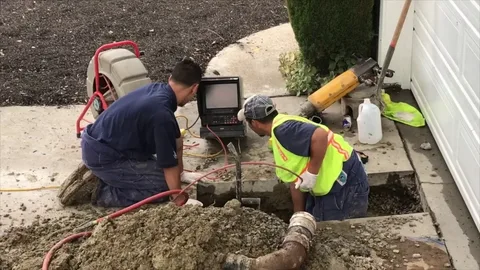
Before any method gets picked, the camera goes through the sewer line first. The plumber watches what the camera shows from inside, cracks , root intrusion, collapsed sections, shifted joints, and the general state of the pipe wall. This kind of observation is what decides which trenchless approach makes sense, or if old-school excavation is honestly the right answer. If someone skips the camera and immediately suggests a repair method before looking at the pipe, that’s a red flag worth paying close attention to.
Pipe bursting is for those situations where the existing pipe is so far gone that any lining cannot reasonably hold. A hardened burst head gets drawn or dragged through the old pipe. As it travels along it breaks the old pipe apart and shoves the fragments into the surrounding soil, kind of like spreading gravel after it breaks loose. Then a new pipe gets pulled in behind that bursting head, and it occupies the exact position of the destroyed one. So you end up with a complete pipe swap, no big excavation involved, and it works in cases where lining simply cannot.
The pipe lining method is also known as CIPP, or cured-in-place pipe. This process involves feeding a flexible resin-soaked liner through an existing and damaged pipe. When it is in position, the liner gets inflated to press against the old pipe’s interior walls. Then the resin hardens. So what you get is a brand new inner surface within the old pipe. The original pipe stays underground, but it is not the working pipe anymore; the hardened liner takes over that job.
The damaged pipe basically stops working; it is now just a liner that handles the job. This method fixes cracks, leaks, and root damage perfectly. However, if the pipe is partially collapsed or really beat up, lining won’t do the trick since there is nothing left for the liner to stick to.
These are the situations where trenchless sewer line repair makes the most sense over traditional methods:
Trenchless sewer line repair also has limits, and a plumber who does not acknowledge them is overselling the method.
Pipe lining can fail if the existing pipe has collapsed in a few sections, because a liner actually needs the old pipe to act as a kind of support so it keeps its shape while the resin cures. Pipe bursting cannot fix a sewer line that needs its slope corrected because bursting replaces the pipe in the same path at the same grade. Changing the slope requires degging.
Severe structural failure, significant misalignment, or a pipe so deteriorated that neither method can properly address the damage still requires traditional excavation. The camera inspection tells you which situation you are actually in before anyone makes a recommendation.
Your sewer line does not fail without warning. These are the signs that point to a pipe problem rather than a localized clog.
Multiple drains backing up at the same time are a clear sign. One slow drain is almost a minor issue. Every drain in the house responding at once means the problem is in the main line, and a camera inspection is what is needed at that moment.
Get a second opinion from another plumber with a camera before agreeing to dig. It's reasonable, and any legitimate plumber expects it.
Most trenchless jobs finish in one day. Excavation on the same pipe usually runs several days, including surface restoration afterward.
A properly done CIPP liner lasts fifty years or more. Pipe bursting installs new pipe, so it's essentially a full replacement.
The camera inspection answers that. There's no honest way to know without looking inside the pipe first.
Trenchless sewer repair changed how sewer lines work for homeowners who would otherwise have watched their driveway or yard get kind of wrecked just to fix a pipe underneath it. It’s not the perfect answer every single time, and no plumber should ever promise you it is without doing a proper camera inspection first. Still, when the pipe does qualify, and the right technique gets paired to what the camera shows, the whole job gets handled without leaving your property looking like a construction site afterward, you know, when they’re finished.
See signs of a failing sewer line? Give us a call! We’ll send a camera to check it out and see if trenchless repair works for you. Let’s figure out what’s really going on and find a good solution.
Your Local Plumbing is Tacoma’s best choice for residential and commercial plumbing solutions you can always count on.